The Birth of Venus
A true artist, in order to create the work which shall live as “a joy forever,” in many ways resembles the ascetic who selects, as an altar for his profound devotion, the green remoteness of the woods.
After having removed himself from the sordid doings of the common daily life and having broken all evil contacts with infesting crowds, liable to contaminate, he feels uplifted into superior regions, where everything appears transfigured, spiritualized by supernatural light. It is the atmosphere of fire, the state of grace, the moment for the miracles, the moment encircling with a glorious halo the life of St. Francis.
Suddenly the solitude is struck by the lightning of REVELATION and the artist is seized with ecstasy – ecstasy at a whole theory of visions unfolding inexhaustible wealth of forms and colors through the unlimited blue of Heaven. It is then that Inspiration begins to sing with vehemence, it is then that all energies of the artist – unorganized before – arise linked in a superb effective unity, prompted to action by the law of inevitability of the natural forces.
Various and dissimilar are the visions. Some gleam afar, starlike, tokens of incomparable treasures to be some day unsealed in their plenitude, some appear and disappear at the same time, but leaving in our memory an echo forever quivering with the music of their passage; and some reveal themselves in fragments, to reappear in their fullness, to be pursued and seized little by little by a patient, obdurate daily practice: Nulla dies sine linea (not one day without a line) (GIOTTO). But some, in a vivid, precise definition of the whole, remain for days as hunting marvel, tyrannical in their dominion of the soul, imperatively exacting an immediate translation into the eternal idiom of Art.
It is the vision similar to the fruit falling while ripe; the vision born – undetected – at the bottom of the unconscious, secretely fed for years by the ardent pursuit of Art and showing itself at the opportune moment, at the full growth of the artistic faculties. Sometimes it is the word of fire by a cherished poet or a painting portraying some of our dreams that acts as the magic voice of appeal generating this miracle: for real Art has force of expansion, of continuity into future harvests. The work of the artist – carrier of fire – is a seed of perennial fecundity confided to the GODDESS OF JOY presiding at the CELEBRATION OF BEAUTY in the evergreen fields of ART.
The first idea of painting VENUS suddenly occurred to me when I was struck by this verse of Anacreon: “Who did sculpt the blue sea?” Instantaneously a terse blue sea expanded in front of me. It arose in an apotheosis, culminating in the radiant form of Venus.
I was shaken with joy as if I had suddenly discovered a treasure long sought for. Thrilled by the idea of possession, I was assaulted by a violent desire to quickly realize this idea in painting, for my joy and the joy of others. But long and difficult is the road leading to conquest; and the delightful tormenting chase after a hide-and-seek game with the elusive Graces so well known to the artist, at the beginning of his work, is similar in many ways to the experience of someone who has to remain painfully perched upon a slippery wall to enjoy the privilege of seeing a marvelous apparition.
I felt that long and assiduous should be my courtship of the Goddess to win her smiles, and with the painstaking zeal of the true lover, I tried every means to render my artistic ability worthy of the arduous task. I knew of her many worshippers of all times; so many, alas! worthier than I.
I went to the sea. I breathed its free air. I watched and questioned every ripple of the waves. Besides, I went to the Museum of Natural History to be initiated by my ardent curiosity into the strange lore of the marine Flora; and in drawing the matchless purity of the curves of the shells smiling with multicolored lights or the rebellious sinuosities of the corals springing from unseen Medusas, I put myself in close contact with natural wonders. to refresh and rebuild my chromatic vision, I went to the flowers to learn the secret of the vibration of their colors, and having gathered an harvest of material, fit for the background and the surroundings of my picture, I unfolded before me all these wonders as appealing gifts for the Advent of THE GODDESS.
And Venus arose in all the glory of her prime as the culminating point of the spiral forces of the shell – the essence of a miraculous lotus. I selected the lotus as the source of Beauty (the myth of Venus is the myth of Beauty) because its color, so intense at the point where the elevation of its petals converge, is the true echo of the rosy birth of Dawn, the animator of the festanti cori crowning Smiling Youth: because the fibers, the curves of its petals are to Jupiter the models of perfection of line for the limbs of his Goddesses. I painted Venus in the center, drawing to her all the lines of my composition. I gave her a distant look, a dominating attitude, and I put two birds (symbols of the flight and the singing of Love) upon her arms, poised on a forehead, which I tried to endow with the holy purity of an altar, of a shrine.
I divided my composition into two main colors: the blue of the sky and the green of the sea. My Sky was drawn from the serenity of my youth in Italy, displaying a cloudless purity of blue and arched as a protecting benediction, pouring flowers from its celestial gardens. And in rivalry I gave the sea a terse crystalline transparency for a clear definition of the shells – shells opening at the bottom, at the corners, as the winged phrases of the untold poem of the sea.
And as ministers presiding and officiating at the festa, I imagined the fishes – those stars and flowers of the sea – as seraphins playing the music of their gliding movements in an oblique ascentional rhythm of joy on both sides of their Goddess, towards the ripple of the blue waves, above, opening as circles of caresses enclosing in the candid crests smiles of roses and the mirthful bewilderment of Cupid.
Stella was an Italian-born artist who worked out of New York, NY – bouncing between artistic styles every few years. The main movements he participated in were Dadaism, Precisionism, Cubism, and Futurism.
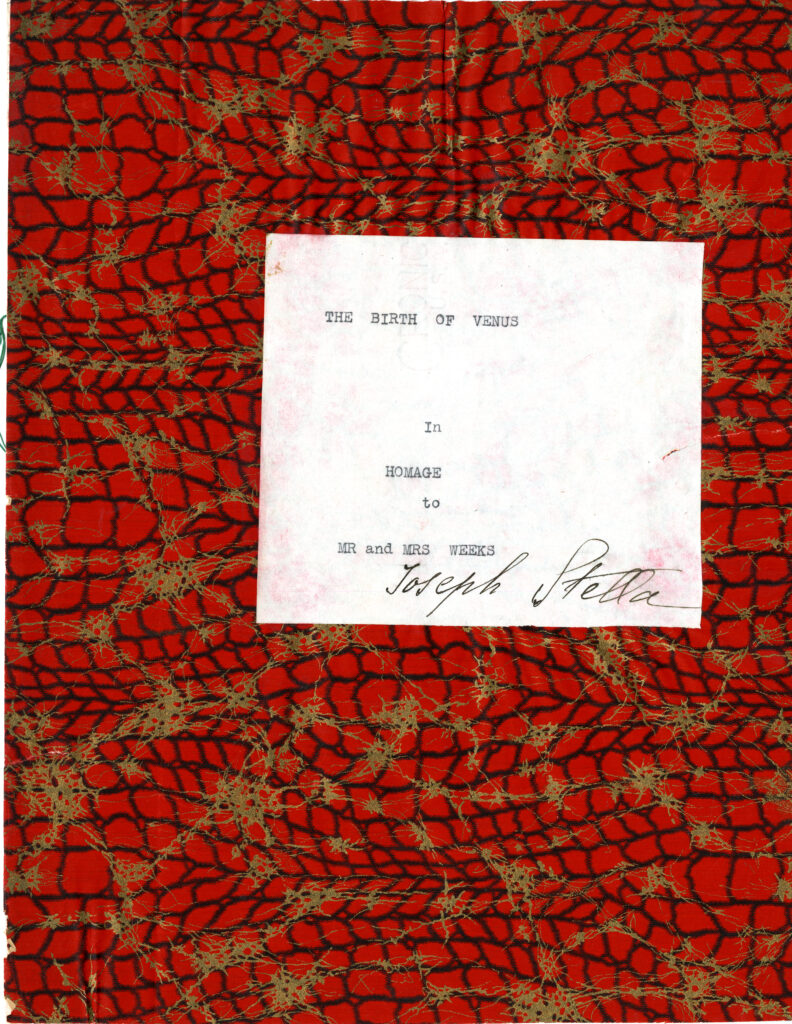
The essay here – The Birth of Venus – works in tandem with a painting of Stella’s by the same name (on display in Salisbury House’s Great Hall). It was Stella’s first major sale and the beginning of a fruitful artist-patron relationship between him and Carl and Edith Weeks. He painted Venus while back home in Italy as part of a larger series inspired by Italian/Roman folklore and myth. Stella was also stylistically inspired by the Italian Renaissance during this time frame.
Stella’s essay reveals an ecstatic spiritual experience in the creation of The Birth of Venus, and is a verbose piece writing. The art circles Stella operated in overlapped with the modernist writing movement, including the likes of Gertrude Stein, Ernest Hemmingway, and F. Scott Fitzgerald and that overlap is abundantly clear in Stella’s writing style.
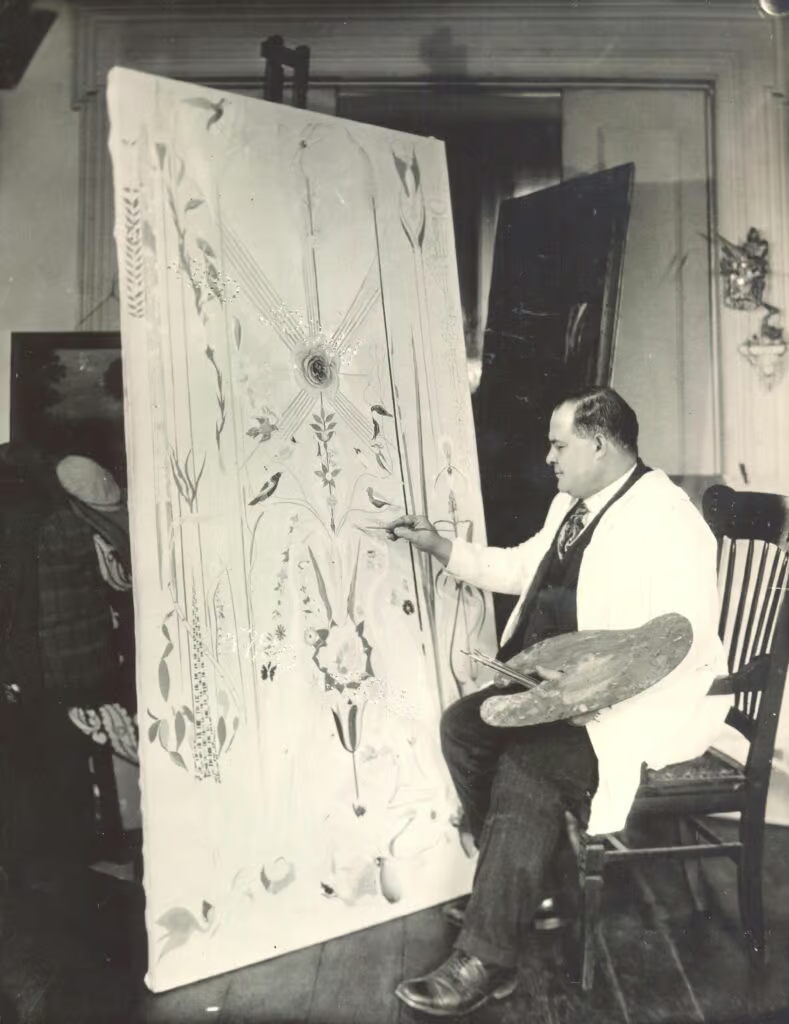
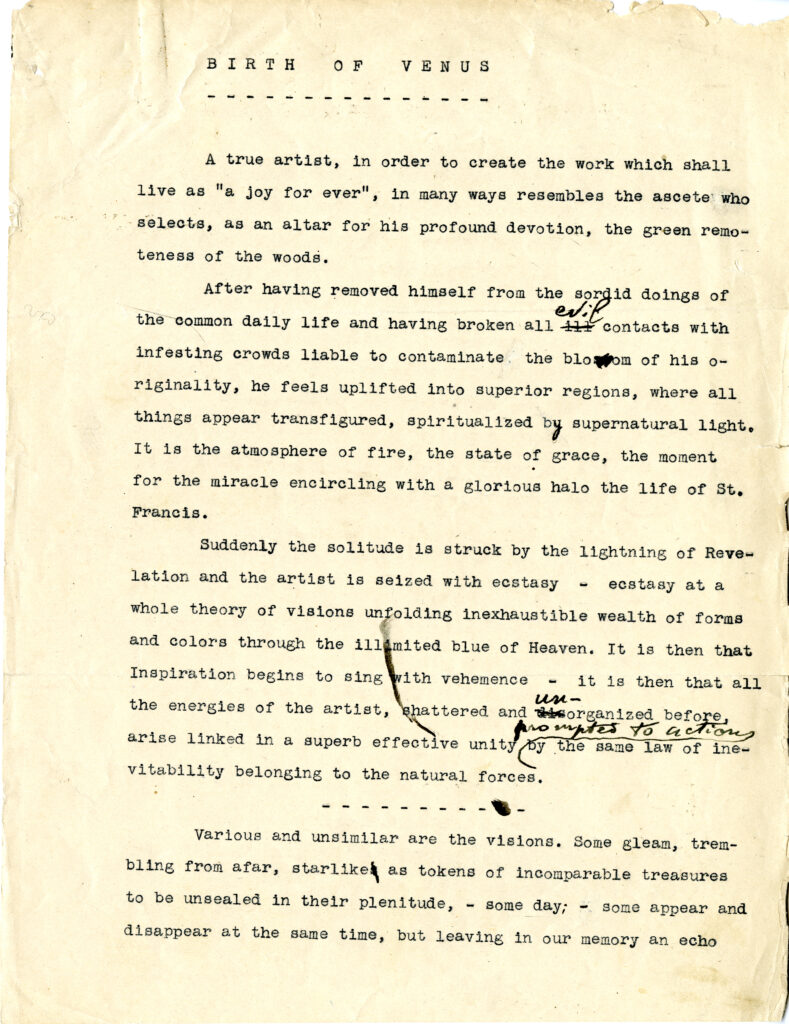
- August and September 2025; with a photo of the artist and early draft with edits possibly made by Carl Weeks (SHLC); rotating library display case